What Happens If Your Sleep Schedule Is Inconsistent?
If your bedtime and wake time change frequently, you may notice that your sleep feels unpredictable. One night you fall asleep quickly. The next night you’re wide awake. Monday mornings feel harder than Friday mornings.
This often happens when your sleep schedule is inconsistent.
Your circadian rhythm relies on stable timing cues. When those cues vary widely, your internal clock becomes less predictable, which affects sleep quality and daytime energy.
Quick Answer
An inconsistent sleep schedule can disrupt your circadian rhythm, making it harder to fall asleep, wake up refreshed, and maintain steady energy throughout the day. Consistent timing strengthens sleep quality over time.
Why Consistency Matters For Sleep
Your body runs on a roughly 24-hour rhythm called the circadian rhythm.
This rhythm controls:
- Melatonin release
- Alertness
- Body temperature
- Sleep timing
- Hormone cycles
When you wake and sleep at similar times each day, your rhythm becomes stable.
When those times shift frequently, your rhythm weakens.
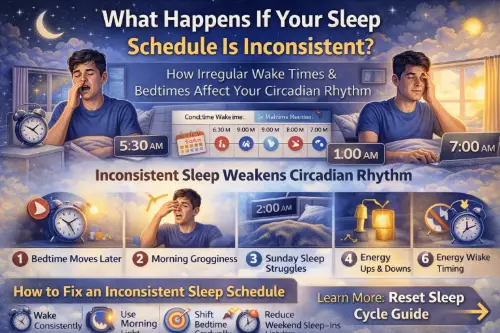
What Happens When Your Sleep Schedule Is Inconsistent?
1. Bedtime Becomes Unpredictable
If you go to bed at 10 PM one night and 1 AM the next, your body doesn’t know when to prepare for sleep.
Melatonin release may shift later, making it harder to fall asleep consistently.
2. Morning Grogginess Increases
Changing wake times frequently can disrupt morning alertness signals.
This often leads to:
- Hitting snooze repeatedly
- Feeling sluggish after waking
- Needing extra caffeine
3. Sunday Night Sleep Gets Harder
Large weekend sleep-ins can create a pattern known as social jet lag.
You can learn more here: What Is Social Jet Lag?
4. Energy Fluctuates Throughout the Day
When rhythm timing shifts, you may experience:
- Afternoon crashes
- Late-night second wind
- Irregular hunger timing
- Mood variability
Even small inconsistencies compound over time.
If your schedule has drifted significantly, you can use the reset sleep cycle guide to rebuild stability
How Much Variation Is Too Much?
Minor variation is normal.
Most sleep experts recommend keeping wake time within about 60 minutes across the week.
When the difference grows to 2–4 hours between weekdays and weekends, rhythm disruption becomes more noticeable.
Can An Inconsistent Sleep Schedule Cause Long-Term Issues?
Short-term inconsistency may simply cause fatigue.
Long-term rhythm instability may contribute to:
- Reduced sleep quality
- Persistent tiredness
- Difficulty falling asleep
- Difficulty waking at a desired time
Stability protects rhythm health.
How To Fix An Inconsistent Sleep Schedule
If your schedule has drifted, focus on timing cues.
1. Anchor Your Wake Time
Choose a wake time and stick to it daily.
Wake time influences rhythm more strongly than bedtime.
2. Use Morning Light Exposure
Bright light shortly after waking strengthens your daytime signal.
3. Shift Bedtime Gradually
If needed, adjust bedtime in 15–30 minute increments.
Avoid large jumps.
4. Reduce Weekend Sleep-Ins
Try to keep weekend wake time close to weekday timing.
For a structured approach, review: Reset Sleep Cycle Guide
Or follow the phased method: Sleep Reset Framework
How Long Does It Take To Stabilize?
Mild inconsistency often improves within 5–7 days.
More significant timing drift may require 1–2 weeks of steady wake time anchoring.
For full timeline details: How Long Does It Take to Reset Your Sleep Cycle?
Frequently Asked Questions
Is it bad to sleep at different times every night?
Occasional variation is normal, but frequent large shifts can weaken circadian rhythm stability.
How consistent does sleep need to be?
Keeping wake time within about one hour daily supports rhythm stability.
Why does my sleep feel worse on Mondays?
Large weekend schedule shifts often delay your rhythm, making Sunday night sleep harder.
Key Takeaway
An inconsistent sleep schedule can weaken your circadian rhythm and make sleep less predictable. Stabilizing wake time and reducing large timing shifts can significantly improve sleep quality and daytime energy.
Important Note
This article provides general educational information about sleep timing and rhythm stability. It is not intended to diagnose or treat medical sleep conditions. If you experience persistent or severe sleep concerns, consult a qualified healthcare professional.
Optional Resource: Sleep Blueprint Guide
Leave a Reply
You must be logged in to post a comment.