Circadian Rhythm Explained: How Your Internal Clock Controls Sleep
Your body runs on a roughly 24-hour internal timing system called the circadian rhythm.
This biological clock influences when you feel alert, when you feel sleepy, how your hormones fluctuate, and how your sleep timing stabilizes.
Understanding circadian rhythm is one of the most important steps in improving sleep consistency, resetting a disrupted schedule, and preventing long-term timing drift.
Quick Explanation
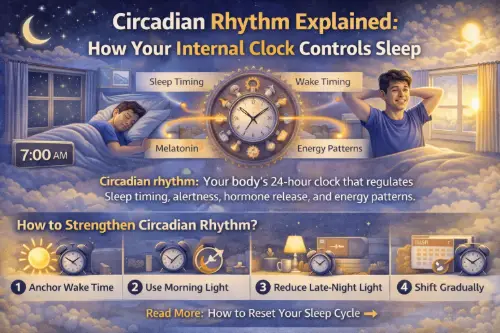
The circadian rhythm is your body’s internal 24-hour clock that regulates sleep timing, alertness, hormone release, and energy patterns. It responds strongly to light exposure and wake time consistency.
What Does The Circadian Rhythm Control?
Your circadian rhythm influences:
- Sleep and wake timing
- Melatonin release
- Cortisol timing
- Body temperature cycles
- Hunger patterns
- Energy fluctuations
When this system is stable, sleep feels predictable.
When it becomes misaligned, bedtime and wake time feel inconsistent.
How The Circadian Rhythm Works
Your internal clock is influenced by environmental cues, called “zeitgebers,” which help synchronize timing.
The most powerful cues include:
1. Light Exposure
Morning light shifts your rhythm earlier.
Late-night light shifts it later.
Light is the strongest timing signal your brain responds to.
2. Wake Time
Consistent wake time anchors your internal clock.
Changing wake time frequently weakens rhythm stability.
Learn more here: Best Wake-Up Time for Better Sleep
3. Bedtime Consistency
Bedtime matters, but wake time has a stronger influence on rhythm alignment.
If bedtime varies but wake time stays stable, rhythm usually stabilizes faster.
4. Routine and Activity
Meal timing, movement, and daily habits reinforce your rhythm patterns.
What Happens When Circadian Rhythm Is Disrupted?
Circadian disruption can occur from:
- Late-night screen exposure
- Weekend sleep-ins
- Shifted wake times
- Staying up all night
- Travel across time zones
When rhythm timing shifts, you may experience:
- Difficulty falling asleep
- Feeling wired at night
- Morning grogginess
- Energy crashes
- Sunday night insomnia
For example: Why You Feel More Awake at Night Than in the Morning
Circadian Rhythm vs Sleep Stages
- Circadian rhythm controls when you sleep.
- Sleep stages control what happens during sleep.
- You can have healthy sleep stages but poor timing — or strong timing but short duration.
- Sleep timing stability is the foundation.
How Circadian Rhythm Drifts Over Time
Timing drift usually happens gradually.
Common patterns include:
- Sleeping in later on weekends
- Going to bed later each night
- Reduced morning light exposure
- Irregular daily schedules
This drift is often called social jet lag.
Learn more here: What Is Social Jet Lag?
How To Strengthen Your Circadian Rhythm
The goal is not perfection. It is consistency.
1. Anchor Your Wake Time
Wake up at the same time daily, including weekends when possible.
2. Use Morning Light
Expose yourself to natural light within 30 minutes of waking.
3. Reduce Late-Night Light
Dim lights 60–90 minutes before bed.
4. Shift Timing Gradually
If correcting drift, adjust bedtime in 15–30 minute increments.
If your timing feels off, you can follow a structured plan in the reset sleep cycle guide to gradually realign your rhythm.
How Long Does It Take To Realign Circadian Rhythm?
Mild timing drift may correct within 3–5 days.
More significant disruption often requires 7–14 days of consistent timing cues.
Full breakdown here: How Long Does It Take to Reset Your Sleep Cycle?
Circadian Rhythm and Delayed Sleep Patterns
When your rhythm shifts later, you may feel:
- Alert late at night
- Tired in the morning
- Motivated at bedtime
- Low energy early in the day
This is often described as a delayed sleep schedule.
Learn how to fix it: How to Fix a Delayed Sleep Schedule
Maintaining Long-Term Stability
Once your rhythm stabilizes, maintenance requires:
- Protecting wake time
- Reducing weekend variability
- Correcting small drift early
For long-term strategies: How to Maintain a Consistent Sleep Schedule
Frequently Asked Questions
Is circadian rhythm the same as your sleep cycle?
No. Circadian rhythm controls daily timing, while sleep cycles refer to the stages of sleep that occur during the night.
Can you reset your circadian rhythm?
Yes. Consistent wake time, morning light exposure, and gradual bedtime adjustments can realign circadian timing.
What causes circadian rhythm disruption?
Common causes include inconsistent wake times, late-night light exposure, weekend schedule shifts, and travel.
Key Takeaway
Circadian rhythm is your internal timing system that regulates when you feel alert and when you feel sleepy. Stabilizing wake time, using morning light, and reducing large schedule shifts can strengthen rhythm alignment and improve sleep predictability.
Important Note
This article provides general educational information about sleep timing and circadian rhythm. It is not intended to diagnose or treat medical sleep conditions. If you experience persistent or severe sleep concerns, consult a qualified healthcare professional.
How To Maintain A Consistent Sleep Schedule Long Term
Resetting your sleep schedule is one step. Maintaining it long term is what protects your sleep quality.
Many people successfully shift their schedule earlier or correct a delay — but a few weeks later, bedtime begins drifting again. Weekend sleep-ins creep in. Wake times vary. Gradually, the rhythm weakens.
The key to long-term sleep stability is protecting your wake time anchor and managing small timing shifts before they grow.
Quick Answer
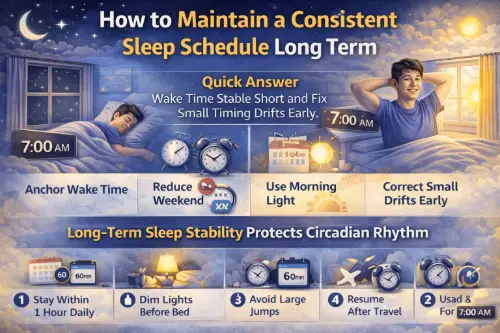
To maintain a consistent sleep schedule long term, wake up at the same time daily, manage weekend variability, use morning light exposure, and correct small timing drifts early. Stability protects circadian rhythm strength.
Why Sleep Schedules Drift Over Time
Sleep timing rarely shifts dramatically overnight. It drifts gradually.
Common causes include:
- Sleeping in on weekends
- Staying up later on Friday and Saturday
- Travel or temporary stress
- Reduced morning light exposure
- Irregular evening routines
Small shifts compound across weeks.
The Most Important Rule: Protect Your Wake Time
Wake time is the foundation of circadian rhythm stability.
Even if bedtime varies slightly, consistent wake time helps:
- Regulate melatonin release
- Improve morning alertness
- Stabilize bedtime naturally
- Reduce sleep onset difficulty
Keep wake time within about 60 minutes daily whenever possible.
How To Prevent Weekend Schedule Drift
Weekend schedule shifts are one of the most common causes of rhythm disruption.
To reduce drift:
- Keep wake time within 60 minutes of weekday timing
- Go to bed slightly earlier if extra rest is needed
- Avoid sleeping in several hours later
Large weekend shifts often lead to Sunday night sleep difficulty.
Learn more here: What Is Social Jet Lag?
Use Morning Light Strategically
Morning light exposure strengthens circadian rhythm timing.
Try to:
- Get daylight within 30 minutes of waking
- Open curtains immediately
- Step outside briefly if possible
Light tells your body that the day has begun and reinforces stable timing.
Correct Small Drifts Early
If your bedtime shifts later by about 30 to 60 minutes for a few nights, correct it early. Adjust bedtime in 15 to 30 minute steps until you are back on track. Fixing small drift now is much easier than doing a full reset later.
Read the Reset Sleep Cycle Guide
Maintain A Consistent Evening Routine
A predictable wind-down routine signals your brain that sleep is approaching.
Helpful habits include:
- Dimming lights 60–90 minutes before bed
- Limiting stimulating screen exposure
- Following a calming nightly pattern
Routine consistency reduces bedtime unpredictability.
What To Do After Travel Or Disruption
Occasional disruption is normal.
If your schedule shifts due to travel or a late night:
- Resume your regular wake time immediately
- Prioritize morning light exposure
- Avoid long daytime naps
- Use gradual bedtime adjustments if needed
For recovery after a late night, see: How to Fix a Sleep Schedule After Staying Up All Night
How Long Does It Take To Re-Stabilize?
Minor drift often corrects within 3–5 days.
More significant schedule disruption may require 7–14 days of consistent timing.
You can review timeline details here: How Long Does It Take to Reset Your Sleep Cycle?
Frequently Asked Questions
How strict do I need to be with my sleep schedule?
Perfection is not required. Keeping wake time within about one hour daily maintains rhythm stability.
Is it okay to sleep in occasionally?
Occasional variation is normal, but repeated large shifts can weaken circadian rhythm strength.
What is the most important part of maintaining a sleep schedule?
Consistent wake time is the strongest long-term stabilizer.
Key Takeaway
Maintaining a consistent sleep schedule long term depends on protecting your wake time, limiting weekend variability, and correcting small drifts early. Stability strengthens sleep quality over time.
Important Note
This article provides general educational information about sleep timing and circadian rhythm stability. It is not intended to diagnose or treat medical sleep conditions. If you experience persistent or severe sleep concerns, consult a qualified healthcare professional.
What Happens If Your Sleep Schedule Is Inconsistent?
If your bedtime and wake time change frequently, you may notice that your sleep feels unpredictable. One night you fall asleep quickly. The next night you’re wide awake. Monday mornings feel harder than Friday mornings.
This often happens when your sleep schedule is inconsistent.
Your circadian rhythm relies on stable timing cues. When those cues vary widely, your internal clock becomes less predictable, which affects sleep quality and daytime energy.
Quick Answer
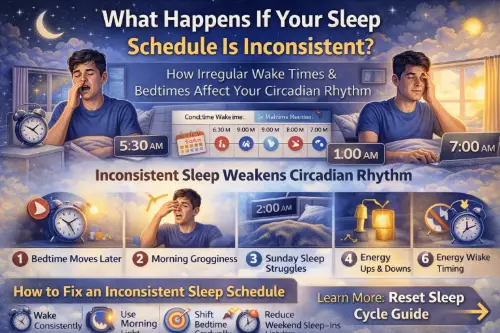
An inconsistent sleep schedule can disrupt your circadian rhythm, making it harder to fall asleep, wake up refreshed, and maintain steady energy throughout the day. Consistent timing strengthens sleep quality over time.
Why Consistency Matters For Sleep
Your body runs on a roughly 24-hour rhythm called the circadian rhythm.
This rhythm controls:
- Melatonin release
- Alertness
- Body temperature
- Sleep timing
- Hormone cycles
When you wake and sleep at similar times each day, your rhythm becomes stable.
When those times shift frequently, your rhythm weakens.
What Happens When Your Sleep Schedule Is Inconsistent?
1. Bedtime Becomes Unpredictable
If you go to bed at 10 PM one night and 1 AM the next, your body doesn’t know when to prepare for sleep.
Melatonin release may shift later, making it harder to fall asleep consistently.
2. Morning Grogginess Increases
Changing wake times frequently can disrupt morning alertness signals.
This often leads to:
- Hitting snooze repeatedly
- Feeling sluggish after waking
- Needing extra caffeine
3. Sunday Night Sleep Gets Harder
Large weekend sleep-ins can create a pattern known as social jet lag.
You can learn more here: What Is Social Jet Lag?
4. Energy Fluctuates Throughout the Day
When rhythm timing shifts, you may experience:
- Afternoon crashes
- Late-night second wind
- Irregular hunger timing
- Mood variability
Even small inconsistencies compound over time.
If your schedule has drifted significantly, you can use the reset sleep cycle guide to rebuild stability
How Much Variation Is Too Much?
Minor variation is normal.
Most sleep experts recommend keeping wake time within about 60 minutes across the week.
When the difference grows to 2–4 hours between weekdays and weekends, rhythm disruption becomes more noticeable.
Can An Inconsistent Sleep Schedule Cause Long-Term Issues?
Short-term inconsistency may simply cause fatigue.
Long-term rhythm instability may contribute to:
- Reduced sleep quality
- Persistent tiredness
- Difficulty falling asleep
- Difficulty waking at a desired time
Stability protects rhythm health.
How To Fix An Inconsistent Sleep Schedule
If your schedule has drifted, focus on timing cues.
1. Anchor Your Wake Time
Choose a wake time and stick to it daily.
Wake time influences rhythm more strongly than bedtime.
2. Use Morning Light Exposure
Bright light shortly after waking strengthens your daytime signal.
3. Shift Bedtime Gradually
If needed, adjust bedtime in 15–30 minute increments.
Avoid large jumps.
4. Reduce Weekend Sleep-Ins
Try to keep weekend wake time close to weekday timing.
For a structured approach, review: Reset Sleep Cycle Guide
Or follow the phased method: Sleep Reset Framework
How Long Does It Take To Stabilize?
Mild inconsistency often improves within 5–7 days.
More significant timing drift may require 1–2 weeks of steady wake time anchoring.
For full timeline details: How Long Does It Take to Reset Your Sleep Cycle?
Frequently Asked Questions
Is it bad to sleep at different times every night?
Occasional variation is normal, but frequent large shifts can weaken circadian rhythm stability.
How consistent does sleep need to be?
Keeping wake time within about one hour daily supports rhythm stability.
Why does my sleep feel worse on Mondays?
Large weekend schedule shifts often delay your rhythm, making Sunday night sleep harder.
Key Takeaway
An inconsistent sleep schedule can weaken your circadian rhythm and make sleep less predictable. Stabilizing wake time and reducing large timing shifts can significantly improve sleep quality and daytime energy.
Important Note
This article provides general educational information about sleep timing and rhythm stability. It is not intended to diagnose or treat medical sleep conditions. If you experience persistent or severe sleep concerns, consult a qualified healthcare professional.
Best Wake-Up Time For Better Sleep (Is 5 AM Necessary?)
You’ve probably heard that waking up at 5 AM is the secret to better sleep, higher productivity, and improved discipline.
But is 5 AM really the best wake-up time for better sleep?
Not necessarily.
The best wake-up time for better sleep is not about a specific hour. It’s about consistency and alignment with your natural rhythm.
Quick Answer
The best wake-up time for better sleep is a consistent time you can maintain every day, including weekends. Consistency matters more than waking up extremely early.
Why Wake Time Matters More Than Bedtime
Your circadian rhythm, your internal body clock, responds strongly to wake time.
When you wake up at the same time every day:
- Your body learns when to release melatonin
- Bedtime becomes more predictable
- Morning alertness improves
- Nighttime sleep pressure builds naturally
Inconsistent wake times are one of the biggest causes of sleep schedule drift.
Is 5 AM Better For Sleep?
Waking at 5 AM is not automatically better for sleep.
It only works if:
- You go to bed early enough
- You consistently wake at that time
- You get adequate total sleep
If waking at 5 AM forces you to cut sleep short, it can actually harm sleep quality and increase fatigue.
The goal is not early wake time.
The goal is stable wake time.
Long-term benefits come from protecting your wake time consistently, which we cover in how to maintain a consistent sleep schedule.
How To Choose The Best Wake-Up Time
The best wake-up time should:
- Match your real-life responsibilities
- Allow 7–9 hours of sleep
- Be sustainable long term
- Stay consistent across weekdays and weekends
If you must wake at 7:00 AM for work, then 7:00 AM is your anchor.
Not 5:00 AM.
What Happens If Your Wake Time Changes Often?
When wake time varies by several hours:
- Your circadian rhythm weakens
- Melatonin timing shifts
- Bedtime becomes unpredictable
- Sunday night sleep often becomes difficult
This pattern is closely related to social jet lag.
You can learn more here: What Is Social Jet Lag?
Early Wake Time vs. Consistent Wake Time
Here’s the key difference:
Early wake time alone does not guarantee better sleep.
Consistent wake time does.
For example:
Person A wakes at 5 AM Monday, 7 AM Tuesday, 9 AM Saturday.
Person B wakes at 7 AM every day.
Person B will likely have a more stable rhythm.
How To Improve Sleep By Stabilizing Wake Time
If you want better sleep quality:
1. Pick a Realistic Wake Time
Choose a time you can maintain daily.
2. Wake at the Same Time Every Day
Including weekends whenever possible.
3. Get Morning Light Exposure
Bright light within 30 minutes of waking strengthens your rhythm.
4. Shift Bedtime Gradually
If your current bedtime doesn’t support your wake time, move it earlier in small increments.
For a full structured plan, read: Reset Sleep Cycle Guide

What If You’re A Night Person?
Some people naturally lean later.
But even late chronotypes benefit from consistent wake time.
The goal is rhythm stability, not forcing yourself into an extreme schedule.
If your timing has drifted significantly, see: How to Fix a Delayed Sleep Schedule
How Long Does It Take To See Improvement?
When wake time becomes stable, many people notice:
- More predictable sleep onset
- Improved morning alertness
- Reduced nighttime “second wind”
Improvements often appear within 5–7 days.
For full timeline details: How Long Does It Take to Reset Your Sleep Cycle?
Frequently Asked Questions
Is waking up at 5 AM healthier?
Waking at 5 AM is only beneficial if it allows adequate sleep and remains consistent.
What time should I wake up for optimal sleep?
The optimal wake time is one that allows 7–9 hours of sleep and stays consistent daily.
Does waking up earlier improve sleep quality?
Earlier waking can improve sleep if it strengthens consistency and light exposure. However, sleep duration must remain adequate.
Key Takeaway
The best wake-up time for better sleep is not a magic hour like 5 AM. It is a consistent wake time that aligns with your responsibilities and allows sufficient sleep. Stability matters more than early rising.
Important Note
This article provides general educational information about sleep timing and circadian rhythm. It is not intended to diagnose or treat medical sleep conditions. If you experience persistent or severe sleep concerns, consult a qualified healthcare professional.
Why You Feel More Awake At Night Than In The Morning
If you feel tired all day but suddenly more alert at night, you’re not imagining it. Many people experience a pattern where energy rises late in the evening and mornings feel difficult.
This usually isn’t about motivation or discipline. It’s often related to how your internal clock is timed.
Your body follows a circadian rhythm — a roughly 24-hour cycle that controls alertness, melatonin release, and sleep timing. When that rhythm shifts later, you may feel most awake at night instead of in the morning.
Quick Answer
You feel more awake at night than in the morning when your circadian rhythm is delayed. Late wake times, nighttime light exposure, and inconsistent sleep schedules can shift your internal clock later, increasing nighttime alertness.
What Is A Delayed Circadian Rhythm?
Your circadian rhythm regulates:
- Sleepiness
- Alertness
- Hormone release
- Body temperature
- Energy patterns
When this rhythm is aligned, you feel sleepy at night and alert in the morning.
When it shifts later, your natural sleep window moves deeper into the night.
This can create a pattern like:
- Groggy mornings
- Low midday energy
- Second wind at 9–11 PM
- Feeling wired at bedtime
Why Does This Happen?
Several factors can shift your rhythm later.
1. Inconsistent Wake Times
Sleeping in on weekends or varying wake time during the week gradually pushes your internal clock later.
2. Late-Night Light Exposure
Bright screens and indoor lighting at night suppress melatonin, the hormone that promotes sleep.
Even small amounts of light close to bedtime can delay sleep timing.
3. Reduced Morning Light
Morning light anchors your circadian rhythm earlier. If you wake in darkness or remain indoors without bright light, your rhythm may drift later.
4. Irregular Bedtimes
Going to bed at different times each night weakens timing signals and makes rhythm less predictable.
5. Stress and Overstimulation
Late-night work, intense content, or overthinking can increase alertness close to bedtime.
This is commonly part of a delayed pattern that can be corrected using strategies in how to fix a delayed sleep schedule.

Is This The Same As Being A “Night Owl”?
Some people naturally prefer later timing, but extreme nighttime alertness combined with morning difficulty is often rhythm drift rather than fixed personality.
Most sleep timing patterns can shift earlier with consistent correction.
How To Shift Your Energy Earlier
If you want to feel more awake in the morning and less wired at night, focus on timing cues.
1. Anchor Your Wake Time
Wake at the same time daily, including weekends.
Wake time consistency is more powerful than bedtime.
2. Get Bright Morning Light
Expose yourself to daylight within 30 minutes of waking.
This strengthens your rhythm’s daytime signal.
3. Dim Lights in the Evening
Reduce brightness 60–90 minutes before bed.
Lower light tells your brain that night is approaching.
4. Avoid Late Stimulation
Limit intense screen use, heavy exercise, or emotionally stimulating content close to bedtime.
5. Shift Bedtime Gradually
Move bedtime earlier by 15–30 minutes every few days.
Avoid drastic changes.
For a structured approach, see: Reset Sleep Cycle Guide
How Long Does It Take To Shift Earlier?
Mild delays may improve within 5–7 days.
More significant timing drift may require 1–2 weeks of consistent wake anchoring and light management.
For full timeline details, read: How Long Does It Take to Reset Your Sleep Cycle?
When To Consider Additional Support
If you consistently cannot fall asleep until very late for months or years, and early wake times feel nearly impossible, you may benefit from speaking with a qualified healthcare professional for evaluation.
Frequently Asked Questions
Why do I get a burst of energy at night?
Late-night alertness often happens when your circadian rhythm is shifted later than your preferred schedule.
Why am I tired all day but awake at bedtime?
Your body clock may be signaling alertness at night due to inconsistent timing cues.
Can you change from a night person to a morning person?
Gradual timing adjustments and consistent light exposure can shift energy patterns earlier for most people.
Key Takeaway
Feeling more awake at night than in the morning usually reflects a delayed circadian rhythm. By anchoring wake time, using morning light, and reducing evening stimulation, you can gradually shift your energy earlier and restore balance.
Important Note
This article provides general educational information about sleep timing and circadian rhythm. It is not intended to diagnose or treat medical sleep conditions. If you experience persistent or severe sleep concerns, consult a qualified healthcare professional.