Tired of Tossing? 7 Simple Sleep Hacks For Instantly Better Sleep
If you’ve been lying awake at night staring at the ceiling, you’re not alone. Millions of people struggle with falling asleep or staying asleep, but the good news is that a few small changes can make a big difference. Whether you’re battling a restless mind or an unpredictable sleep schedule, these 7 simple sleep hacks can help you get the better sleep you’ve been craving.
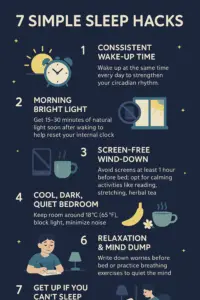
Try These 7 Simple Sleep Hacks:
1. Stick to a Consistent Sleep Schedule
Your body has its own internal clock — the circadian rhythm — and it loves routine.
* What to do: Go to bed and wake up at the same time every day, even on weekends.
* Why it works: A consistent sleep-wake schedule trains your body to naturally feel sleepy at bedtime and alert in the morning.
Pro Tip: Avoid sleeping in more than an hour later on weekends to prevent “social jet lag.”
2. Create a Sleep-Friendly Bedroom
The right environment sets the stage for a restful night.
* Darkness: Use blackout curtains or an eye mask to block out light.
* Cool Temperature: Aim for 60–67°F (15–19°C) for optimal comfort.
* Quiet: Use earplugs or a white noise machine to block disruptive sounds.
Pro Tip: Keep electronics out of the bedroom to reduce blue light and temptation.
3. Limit Screen Time Before Bed
Blue light from phones, tablets, and computers can delay melatonin production — the hormone that helps you sleep.
* What to do: Turn off screens at least 1 hour before bed.
* Alternative: Read a physical book, listen to calming music, or do light stretching.
Pro Tip: If you must use devices, switch to night mode or wear blue-light-blocking glasses.

4. Watch Your Evening Diet
What you eat and drink before bed can either help or hurt your sleep.
* Avoid: Heavy meals, caffeine, and alcohol within 3–4 hours of bedtime.
* Enjoy: Light snacks like a banana, yogurt, or almonds if you’re hungry.
Pro Tip: Herbal teas like chamomile or peppermint can help you unwind naturally.
5. Get Morning Sunlight
Believe it or not, better sleep starts in the morning.
* What to do: Spend 10–20 minutes outside shortly after waking.
* Why it works: Natural sunlight helps regulate your circadian rhythm, making it easier to fall asleep at night.
Pro Tip: If outdoor sunlight isn’t possible, use a light therapy lamp.
6. Practice a Relaxation Routine
Signal to your brain that it’s time to wind down.
* Ideas: Meditation, gentle yoga, journaling, or deep breathing exercises.
* Why it works: These activities reduce stress hormones like cortisol, making it easier to drift off.
Pro Tip: Pair relaxation with dim lighting to reinforce your bedtime signal.
7. Move Your Body (But Not Right Before Bed)
Regular exercise improves sleep quality, but timing matters.
* What to do: Aim for at least 30 minutes of moderate activity most days.
* When to do it: Finish workouts at least 3 hours before bedtime to avoid overstimulation.
Pro Tip: Morning or afternoon workouts often provide the best sleep benefits.
Better sleep doesn’t always require a complete lifestyle overhaul, sometimes, it’s just a matter of consistent habits and small tweaks.
By following these 7 simple sleep hacks, you can create the perfect conditions for your body and mind to rest, recharge, and wake up feeling refreshed.
Recommended Reading
Unlock Deeper Sleep: Why You Must Avoid Screens Before Bed
Are restless nights and groggy mornings your norm? Many people know they should avoid screens before bed, but few realize just how big an impact it can have on their sleep quality. The blue light from phones, tablets, and TVs doesn’t just delay melatonin, it can completely throw off your circadian rhythm, keeping you wired […]
Best Mattress (2025) – The Only Buyer’s Guide You’ll Need
Finding the best mattress in 2025 shouldn’t feel like a trust fall with your spine. The market is crowded, specs are confusing, and every brand claims to be “the perfect blend of comfort and support.”
This guide cuts through the noise with a clear process: how to choose the right mattress for your body, sleeping position, and budget — plus what to ignore, what actually matters, and how to avoid common traps.
Whether you’re replacing a saggy 10-year-old bed, upgrading for back pain, or choosing your first mattress-in-a-box, start here.
Quick Take: How To Choose The Best Mattress In 60 Seconds
* Side sleepers: prioritize pressure relief (plush to medium firmness, generous comfort layers with memory foam or latex).
* Back sleepers: look for neutral spinal alignment (medium to medium-firm with zoned support or responsive coils).
* Stomach sleepers: favor firmer support (medium-firm to firm; thin plushness but strong core to prevent hip sink).
* Hot sleepers: choose breathable builds (hybrids, ventilated foams, latex, phase-change or graphite-infused covers).
* Couples: focus on motion isolation (memory foam or pocketed coils), edge support, and a middle-ground firmness.
* Plus-size (225+ lb): pick reinforced coils and thicker profiles (12–14″+) so you don’t bottom out.
* Back pain: prioritize zoned support and medium-firm feel; pair with a supportive pillow and good sleep posture.
* Budget: set expectations by tier (see the Budget Guide below), then shop warranties/return windows and trial length.
If you only do one thing: buy for your sleeping position and body weight first — the rest is optimization.
The Best Mattress Types (Plain English)
* Memory foam (polyurethane visco): deep pressure relief and excellent motion isolation; can sleep warm if not ventilated.
* Latex (natural or blended): buoyant, durable, cooler, and more eco-friendly; great for combo sleepers and heavier bodies.
* Hybrid (coils + foam/latex): best balance of support, airflow, and bounce; great all-rounder for couples.
* Innerspring (pocketed coils + thin foam): classic feel, strong edges, high airflow; less contour unless comfort layer is plush.
* All-foam (non-visco): budget-friendly, lighter to move, can be responsive or plush depending on densities used.
If you’re unsure, a hybrid with pocketed coils and pressure-relieving comfort layers fits most people.
Firmness: The Real-World Scale
* Soft (3–4/10): best for strict side sleepers under ~180 lb who need deep shoulder/hip relief.
* Medium (5–6/10): “Goldilocks” for combination and back sleepers; most couple-friendly.
* Medium-Firm (6.5–7/10): supports back and stomach sleeping, plus heavier bodies.
* Firm (8/10): niche for stomach sleepers and those who prefer a very flat surface.
Remember: “soft” and “firm” aren’t standardized. A brand’s 6/10 might feel like another’s 7/10. Treat firmness charts as guides, not gospel.
What Actually Matters (and What Doesn’t)
1) Spinal Alignment > Everything
You want your ears–shoulders–hips aligned in your natural posture. Too soft and your hips drop; too firm and your shoulders can’t sink (especially side sleepers), making your spine curve.
2) Pressure Relief Where You Need It
Side sleepers should feel the shoulder and hip sink slightly, with support underneath. Back sleepers want gentle lumbar fill — not a hard board, not a hammock.
3) Support That Matches Your Weight
Heavier bodies compress more. You’ll generally need thicker comfort layers and stronger coil gauges (or high-density foam cores) so the bed doesn’t flatten out in 6 months.
4) Temperature Regulation Is a System
Covers, foams, airflow, and your bedding all interact. Hybrids and latex tend to sleep cooler. Cooling covers help, but don’t expect miracle icebox temperatures from a thin fabric alone.
5) Quality Indicators (that aren’t marketing hype)
* Foam density: For memory foam, look for ~3–4 lb/ft³ (standard) up to 5 lb/ft³ (premium). For base foam, >1.8 lb/ft³ is more durable.
* Coil design: Individually pocketed coils reduce motion transfer and allow zoning; edge-to-edge coils or a sturdy foam encasement improves edge sitting.
* Cover & quilting: Breathable, removable covers are practical. Phase-change or graphite treatments can help, but airflow from the build matters more.
6) Stuff to Ignore (mostly)
*“Proprietary” names for ordinary materials.
*Microscopically thin “cooling” layers that don’t change airflow.
*Over-the-top celebrity endorsements. Your spine doesn’t care.
2025 Buyer Profiles: Pick Your Path
A) Side Sleeper (Shoulder/hip pressure relief)
* Feel: Plush-medium (5–6/10).
* Build: Hybrid or all-foam with thicker comfort layers (2–4″+), slow-responding memory foam on top or plush latex.
* Watch for: Adequate depth before hitting firmer transition/Core; zoned shoulders can help broader frames.
B) Back Sleeper (Neutral alignment)
* Feel: Medium to medium-firm (6–7/10) with gentle contour.
* Build: Hybrid with lumbar zoning or responsive latex/foam over coils.
* Watch for: A “dip” at the hips after 10 minutes — that’s a red flag.
C) Stomach Sleeper (Prevent hip sway)
* Feel: Medium-firm to firm (7–8/10).
* Build: Thin plushness over a strong core; latex or firm hybrids work well.
* Watch for: Pillows that are too high — they can crank your neck.
D) Combination Sleeper (Toss-and-turn)
* Feel: True medium (6/10) — adaptive but not swampy.
* Build: Latex or hybrid with responsive foams; avoid ultra-slow memory foam stacks.
* Watch for: Excess sink that makes position changes feel “sticky.”
E) Plus-Size (225+ lb)
* Feel: Medium-firm with robust support.
* Build: High coil count hybrids, thicker profiles (13–15″), denser foams, stronger edges.
* Watch for: Shallow comfort layers that “pancake.”
F) Couples
* Priorities: Motion isolation, edge support, middle-ground firmness.
* Build: Pocketed-coil hybrid with memory foam or a dense all-foam; if you’re opposites, consider dual-firmness or split king (two twin XLs).
G) Back Pain / Sore Mornings
* Feel: Medium-firm with zoning; enough top comfort to avoid pressure points.
* Build: Hybrid with lumbar support or latex + zoned coils.
* Watch for: Pillows and sleep posture; the mattress can’t fix a wildly mismatched pillow height.
Cooling & Temperature Control
* Construction: Hybrids > latex > memory foam (general trend).
* Airflow features: Channel-cut foams, open-cell memory foam, coil cavities.
* Cover tech: Phase-change fabrics or graphite can add a few degrees of comfort — useful, not magical.
* Bedding: Breathable cotton/linen, light duvet, and a mattress protector that isn’t a plastic tarp.
Pro move: If you love the feel of memory foam but overheat, choose a hybrid with memory foam comfort layers to get the contour without the heat trap.
Motion Isolation, Edge Support & Bounce
* Best motion isolation: All-foam and memory foam wins (great for light sleepers).
* Best edge sitting: Innerspring or hybrid with reinforced edges/denser perimeter coils.
* Best bounce: Latex and hybrids (easier to move and… other activities).
Couples often land on a medium hybrid with pocketed coils + a foam comfort system for the best “total package.”
Size & Room Fit Cheat Sheet
* Twin/Twin XL: Kids, guest rooms, or split kings.
* Full/Double: Solo sleepers who starfish a bit, small rooms.
* Queen: Most popular; space-friendly for couples.
* King: Maximum sprawl and kid/pet invasions.
* California King: Taller sleepers; narrower but longer than King.
* Measure first — bed + frame + clearance for drawers, doors, and walking space. If your bedroom is tight, a standard Queen is the sweet spot.
Budget Guide (What To Expect By Price)
* Under $500 (Queen): Basic all-foam; fine for guest rooms or light use. May lack cooling and long-term durability.
* $500–$900: Better foams, some entry hybrids, improved covers. Good value for average body weights.
* $900–$1,400: Strong value tier: quality hybrids, zoned coils, breathable covers, thicker profiles.
* $1,400–$2,000+: Premium materials (natural latex, high coil counts, robust edges), longer warranties, better finishing.
* $2,500+: Luxury builds, natural/organic stacks, custom zoning, split firmness options.
Sales are constant. Focus on final delivered price with returns/warranty rather than the pretend “MSRP.”
Warranties, Trials & Returns (Know Your Rights)
* Sleep trials: Commonly 90–365 nights. Take at least 30 nights to adapt.
* Returns: Look for free pickup/return during trial. Some brands charge pickup or require donations.
* Warranty: Typical 10 years; premium/latex can offer 15–25. Understand what counts as a defect (often a visible sag depth, e.g., 0.75–1.5″).
* Foundations: Using an improper base can void your warranty. Slats typically need to be no more than ~3″ apart with a center rail on Queen+.
Pro tip: Screenshot the warranty/return policy at purchase — terms can change on websites.
Certifications & Materials
If you care about emissions or natural materials, look for:
* CertiPUR-US®: Foams made without certain harmful chemicals; low VOC emissions.
* OEKO-TEX® Standard 100: Tests for harmful substances in textiles.
* GREENGUARD Gold: Stricter VOC emissions standard for indoor air quality.
* GOTS / GOLS: Global standards for organic textiles (GOTS) and organic latex (GOLS).
* FSC® / Rainforest Alliance: Responsible sourcing for latex/rubber tree plantations and wood.
Certs aren’t everything, but they’re helpful signals if you’re sensitive or prioritizing eco-criteria.
Unboxing, Off-Gassing & Break-In
Most online mattresses arrive compressed in a box. Expect:
* Setup: 10–30 minutes. Have a second person for heavier hybrids.
* Expansion: Usually 24–72 hours to fully expand, but you can sleep on it day one.
* Off-gassing: A “new bed” smell that fades in a few hours to a couple of days; ventilate the room with open windows and a fan.
* Break-in: Your body and the foams take ~2–4 weeks to settle. Reserve judgment until you’ve slept on it for at least 21–30 nights.
Care, Rotation & Lifespan
* Rotate 180° every 3–6 months (unless zoned specifically for head/foot).
* Spot clean with mild detergent; avoid soaking foams.
* Use a protector to prevent sweat/stains (which can void warranties).
* Lifespan: Quality hybrids and latex can last 8–12 years; all-foam often 6–10 depending on density and use.
Signs it’s time to replace: visible sags, waking stiff or sore, or better sleep when you travel.
Mattress vs. Topper: Which Fix Do You Need?
* A topper helps when the support is fine but you want a plusher surface (e.g., side sleeper on a medium bed).
* A new mattress is better when the core is worn out, you feel dips/sags, or pain started with the current bed.
Adjustable Bases & Accessories (Worth It?)
* Adjustable base: Great for snorers, reflux, reading in bed, or pressure relief (zero-gravity). Make sure your mattress is compatible.
* Pillows: Don’t ignore them. Side sleepers need taller loft; back sleepers medium; stomach sleepers low/soft.
* Sheets/duvets: Breathable cotton or linen if you sleep warm; avoid heat-trapping protectors.
The 7-Step Testing Method (In-Store or at Home)
- Position test: Spend at least 5–10 minutes in your normal sleep position.
- Spine check: Have your partner take a photo from the side. Neck through hips should be roughly straight in that position.
- Pressure scan: Side sleepers — check shoulders/hips for numbness or tingling; back sleepers — check lower back contact.
- Edge sit: Sit and tie a shoe. If you slide off, edge support is weak.
- Partner roll: Have your partner flop or change positions; note disturbance.
- Heat feel: After 10 minutes, notice warmth buildup.
- Morning test (home trial): Are you less sore after 3–5 nights? If not, give it 2–3 weeks before deciding.
Common Myths (Busted)
* “Firm is best for back pain.” Not universally. Many do better on medium-firm with zoning and pressure relief.
* “More layers = better.” Quality > quantity. Two great layers beat six mediocre ones.
* “Cooling gel fixes hot sleep.” It helps, but airflow and construction matter more.
Decision Guide (Cheat Sheet)
If you’re:
* Side sleeper under 180 lb: Plush-medium all-foam or hybrid with thick memory foam comfort.
* Side sleeper 180–250 lb: Medium hybrid with zoned coils and durable top foams/latex.
* Back sleeper most nights: Medium-firm hybrid with light contour; lumbar zoning preferred.
* Stomach sleeper: Firm, supportive core (latex or firm hybrid).
* Hot sleeper: Latex or hybrid; breathable cover + light bedding.
* Couple with different tastes: Medium hybrid, or split king with two firmnesses.
* Heavy (225+ lb): Reinforced hybrid, 13–15″ tall, dense foams.
* Eco-leaning: Natural latex + organic cotton/wool; look for GOLS/GOTS/GREENGUARD.
Best Mattress Comparison Table
| Sleeper Type | Recommended Feel | Best Build | Why It Works | Watch Outs |
|---|---|---|---|---|
| Side | Plush–Medium | Hybrid or All-Foam (thick comfort) | Relieves shoulder/hip pressure | Too soft can tweak lower back |
| Back | Medium–Medium-Firm | Hybrid w/ lumbar zoning | Keeps neutral alignment | Overly firm can cause upper-back tension |
| Stomach | Medium-Firm–Firm | Firm Hybrid or Latex | Prevents hip sink | Too soft causes swayback |
| Combo | Medium (responsive) | Latex or Responsive Hybrid | Easy to move around | Slow foams feel “sticky” |
| Plus-Size | Medium-Firm (thick profile) | Reinforced Hybrid, 13–15″ | Durability + deep support | Shallow comfort layers “bottom out” |
| Couples | Medium (balanced) | Pocketed-Coil Hybrid + Foam | Motion isolation + edge support | Cheap edges collapse over time |
Budget Roadmaps (What to Buy at Each Tier)
Starter ($500–$900, Queen)
*Solid all-foam or entry hybrid
*Prioritize: decent density, at least 10-year warranty, breathable cover
*Great for: guest room, first apartments, lighter bodies
Value ($900–$1,400)
*The sweet spot for most buyers
*Hybrid with pocketed coils, 12–14″ height, pressure-relieving top
*Great for: couples, combo sleepers, warm sleepers
Premium ($1,400–$2,000+)
*Natural latex or high-coil hybrid, zoned support, luxury cover
*Great for: heavier bodies, long-term durability, eco-leaning buyers
How To Avoid Buyer’s Remorse
* Don’t skip the pillow check. Wrong pillow = “bad mattress” 9 times out of 10.
* Actually use the trial. Set a calendar reminder at 21 days and 75 days to reassess.
* Read the fine print. Return fees, restocking, or “exchange only” policies can sting.
* Buy the right base. Slats too far apart or no center support can void warranties and ruin support.
Mattress Frequently Asked Questions
Q: How long should a mattress last?
A: Quality builds typically last 8–12 years (latex and premium hybrids often longer). Rotate periodically and use a protector to extend life.
Q: Can a mattress fix my back pain?
A: A supportive, medium-firm surface with good pressure relief can help, but posture, pillows, and daily habits matter too. If pain persists, see a clinician.
Q: Do I need a box spring?
A: Not usually. Most modern beds work on platform frames or slats. Check your warranty for spacing requirements (often ≤3″ between slats).
Q: Will a cooling cover actually keep me cool?
A: It helps at first contact. For lasting overnight comfort, airflow and build (hybrid/latex) matter more.
Q: What if my partner and I want different firmness levels?
A: Consider a split king (two Twin XLs), a mattress with dual-firmness, or a medium feel plus a topper on one side.
Q: How do I know if it’s too soft or too firm?
A: If you wake with a sore lower back, your hips likely sank (too soft). If your shoulders/hips feel jammed or numb, it’s likely too firm.

Recommended Reading
Our In-Depth Casper Mattress Review Covers The Pros, Cons & Real Value When it comes to buying a new mattress, one name that almost always comes up is Casper. Known as one of the pioneers of the “mattress in a box” trend, Casper has built a reputation for quality, convenience, and comfort. But with so […]
Zinus 10-Inch Green Tea Cooling Memory Foam Mattress Review – Best Budget Memory Foam Pick on Amazon Sleep feeling overheated or sore? The Zinus 10‑Inch Green Tea Cooling Memory Foam Mattress (New Version) could be your affordable solution for cooling comfort and pressure relief. This budget-friendly memory foam favorite on Amazon packs green tea and cooling […]
Tired of waking up with a stiff neck or restless nights? Your pillow might be the problem, but finding the right one doesn’t have to be a nightmare. This guide cuts through the confusion and shows you how to match the perfect pillow to your sleep style, whether you’re a side, back, or stomach sleeper. With […]
Morning Routine Guide: How Your Mornings Shape Your Sleep
Last updated: February 12, 2026
While many people focus on bedtime rituals, restorative sleep often begins much earlier. The way you structure your mornings influences your internal clock, daily energy stability, and how easily your body transitions into rest at night.
Small adjustments: light exposure, movement, nutrition, hydration, caffeine timing, and consistency – work together to reinforce predictable sleep patterns.
This guide breaks down the key morning pillars that support better sleep timing and rhythm.
Understanding The Morning-Night Connection
Your body operates on a circadian rhythm – an internal timing system that regulates sleep-wake cycles, hormones, and daily alertness.
Morning signals are especially powerful.
• Light exposure sets timing cues
• Food and hydration stabilize energy
• Movement reinforces wakefulness
• Stress levels influence evening relaxation
When mornings are chaotic or inconsistent, sleep timing often becomes unpredictable later in the day.
Quick Comparison: Structured vs. Inconsistent Mornings
| Factor | Structured Morning | Inconsistent Morning |
|---|---|---|
| Circadian Rhythm Cues | Clear wake signals, more predictable timing | Mixed signals, less predictable timing |
| Daily Energy | Steadier alertness across the day | Fluctuating energy and alertness |
| Evening Wind-Down | Easier transition toward rest | Harder to fully unwind |
The 7 Pillars Of A Sleep-Supportive Morning

1. Early Light Exposure
Morning light is one of the strongest timing cues for your internal clock.
Natural light exposure helps:
• Signal the body that it’s time to be awake
• Reinforce wakefulness
• Anchor your circadian rhythm
How to apply it:
• Go outside for 10–30 minutes
• Open curtains immediately
• Pair light with coffee or a short walk
Natural light is preferable, but consistent indoor light is better than none.
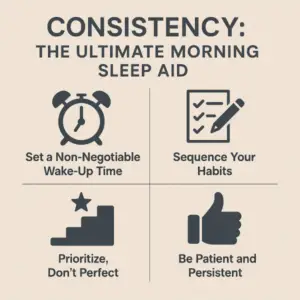
2. Consistent Wake-Up Time
Wake time acts as the anchor for your entire schedule.
Large swings between weekdays and weekends can create “social jet lag,” making bedtime timing inconsistent.
Best practice:
• Wake at the same time daily when possible
• Adjust gradually in 15–30 minute increments
• Prioritize consistency over perfection
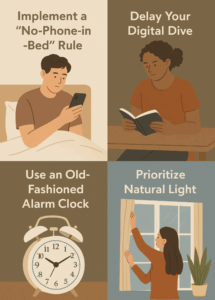
3. Limit Early Morning Screen Exposure
For many people, the first instinct after waking is to reach for a phone, tablet, or laptop. Emails, notifications, and social media can quickly become the first stimulus of the day.
However, early screen exposure may compete with natural light cues that help reinforce your wake time.
Your internal clock responds strongly to light. When digital screens are the first light source your eyes encounter, especially in a dark room, it can blur the distinction between artificial and natural timing signals.
The goal is not to eliminate screens entirely, but to prioritize natural wake cues first.
Screen-Free Morning Practices
• Keep your phone out of reach of the bed
• Delay screen use 30–60 minutes after waking
• Use a separate alarm clock instead of your phone
• Open curtains or step outside before checking notifications
• Set gentle boundaries around early work messages
By prioritizing natural light and calm wake-up cues before digital stimulation, you create clearer timing signals for your day. Over time, this can support more stable morning energy and smoother evening wind-down.

4. Morning Movement
Physical activity reinforces wake signals and supports rhythm stability.
This does not require intensity.
Options:
• Short stretch
• Brief walk
• Light mobility
• Full workout (earlier in day preferred)
If exercising intensely, aim to finish vigorous workouts at least 3–4 hours before bedtime.

5. Balanced Fuel
Your first meal influences energy stability throughout the day.
A balanced breakfast may include:
• Protein (eggs, yogurt, smoothie)
• Complex carbohydrates (oats, whole-grain toast, fruit)
• Healthy fats (nuts, avocado, olive oil)
Avoid large sugar spikes that may contribute to energy crashes later.
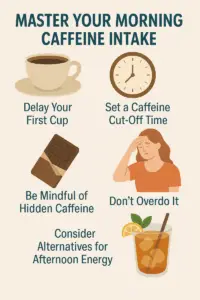
6. Caffeine Timing
Caffeine can support alertness but requires strategic timing.
Consider:
• Waiting 60–90 minutes after waking before first cup
• Avoiding caffeine within 8–10 hours of bedtime
• Accounting for hidden sources (tea, chocolate, sodas)
Because caffeine has a long half-life, afternoon intake can affect nighttime sleep even if you don’t feel overstimulated.

7. Hydration
Rehydrating after waking supports energy, circulation, and comfort.
Practical tips:
• Drink 16–20 oz of water in the morning
• Keep water by your bed
• Reduce fluids later in the evening
Stable hydration during the day may reduce discomfort at night.
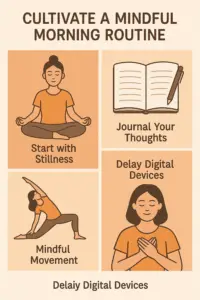
Mindful Mornings and Stress Regulation
Immediate digital overload or rushing can activate your stress response early.
Calm morning practices can help stabilize mental tone for the day.
Examples:
* 5–10 minutes of breathing or meditation
* Brief journaling
* Gratitude reflection
* Delaying phone use 30–60 minutes
Small periods of intentional calm may reduce mental overstimulation later at night.
Consistency: The Multiplier
Each habit works better when performed consistently.
When wake time, light exposure, movement, and meals occur at similar times daily, your internal rhythm becomes more predictable.
Consistency supports:
* More stable hormone timing
* Predictable energy levels
* Smoother evening wind-down
Even partial consistency can improve stability over time.
Making Morning Habits Sustainable
Long-term success depends on realistic implementation.
* Start Small
Choose one or two habits first.
* Use Habit Stacking
Attach new habits to existing ones.
* Prepare the Night Before
Lay out clothes, prep breakfast, set water by bed.
* Stay Flexible
Missing one morning does not undo progress.
* Track Progress
Use a simple calendar or tracker to build momentum.
Optional – Sleep Tracking Apps
If you want additional insight, you may explore sleep tracking apps that monitor sleep timing and patterns.
| App | Platform | Tracks Sleep | Smart Alarm | Snore Detection | Free Limits | Best For |
|---|---|---|---|---|---|---|
| Sleep Cycle | iOS, Android | Yes | Yes | Yes | Ads, limited insights | Gentle wake-up |
| Sleep as Android | Android | Yes | Yes | Yes (mic) | Limited stats | Android users |
| Pillow | iOS | Yes | Yes | Yes | Apple Watch needed | iOS users |
| Sleep Monitor | Android | Basic | Yes | Yes | Ads, limited history | Simple UI |
| SnoreLab | iOS, Android | No | No | Yes | No long-term trends | Snoring focus |
| SleepScore | iOS, Android | Yes | No | No | Limited insights | Science-based |
| PrimeNap | Android | Yes | Yes | No | Limited vs Pro | Lightweight use |
✅ Takeaway: Your nights are shaped by your mornings. By stacking light, movement, fuel, hydration, mindfulness, and consistency into your first hours, you can transform your sleep cycle for deeper, more restorative rest.
How This Connects To The Full Sleep System
Your morning routine works alongside:
* Morning Routine Checklist
* Sleep Consistency Tracker
* Night Routine Guide
* Sleep Score Self-Check
* Start Here
When morning and evening timing align, maintaining rhythm often becomes easier.
Mini Sleep Consistency Snapshot
Here’s a simple example of how a structured morning might look when consistency is the goal. The exact times will vary for each person, but the sequence matters more than perfection.
| Time | Action | Purpose |
|---|---|---|
| 7:00 AM | Wake up | Anchor circadian rhythm |
| 7:05 AM | Light exposure (outdoors or bright room) | Reinforce wake signals |
| 7:10 AM | Hydration | Support energy and circulation |
| 7:20 AM | Light movement or stretch | Reinforce alertness |
| 7:45 AM | Balanced breakfast | Stabilize daily energy |
This example shows how stacking small, repeatable actions creates clearer timing cues. When wake time, light, movement, and meals occur in a predictable order, your body begins to anticipate both alertness and rest more efficiently.
Even if your schedule differs, maintaining a consistent sequence can support more stable energy during the day and a smoother transition into sleep at night.
Key Takeaway
Your nights are influenced by your mornings.
Light exposure, wake time consistency, movement, balanced fuel, hydration, caffeine timing, and stress regulation all reinforce your internal rhythm.
Start small. Build gradually. Focus on patterns, not perfection.
Optional Tools That Support Morning Consistency
* Sunrise Alarm Clock
* Fitness Tracker
* Blue Light Glasses
Important Note
This guide provides educational information for general sleep awareness. It does not diagnose or treat medical sleep conditions. If you experience persistent or severe sleep concerns, consult a qualified healthcare professional.