Unlock Deeper Sleep: Why You Must Avoid Screens Before Bed
Are restless nights and groggy mornings your norm?
Many people know they should avoid screens before bed, but few realize just how big an impact it can have on their sleep quality. The blue light from phones, tablets, and TVs doesn’t just delay melatonin, it can completely throw off your circadian rhythm, keeping you wired when you should be winding down.
By learning why screen use at night disrupts rest and following a few practical strategies to avoid screens, you can set yourself up for faster sleep, deeper rest, and more energized mornings.
The glowing screens you stare at before bed might be the silent saboteur of your sleep. Blue light and late-night stimulation from devices wreak havoc on your body’s natural sleep cycle.
This guide explains the science behind how screens affect your sleep, and more importantly, gives you practical, screen-free strategies to reclaim restorative rest.
The Hidden Sleep Thief: Why Screens Ruin Your Rest
You might think your late-night scrolling or binge-watching session is a harmless way to unwind, but what if I told you that glowing rectangle in your hand or on your wall is actively sabotaging your sleep? It’s not just about losing track of time; there’s a powerful biological reason screens are the hidden sleep thief. The primary culprit is blue light.
The Science of Blue Light
* Phones, tablets, TVs, and laptops emit blue light that mimics daylight
* Blue light suppresses melatonin, your body’s “sleep hormone”
* Without melatonin, your circadian rhythm is thrown off, delaying sleep onset
Melatonin is the signal that tells your body it’s time to wind down and prepare for sleep. When its production is delayed or reduced by screen exposure, your body’s internal clock (circadian rhythm) gets thrown off.
Mental Overstimulation
Even if you dim brightness, the content itself keeps your brain active:
* Binge-watching → keeps your mind engaged in storylines
* Scrolling social feeds → endless novelty triggers alertness
* Late-night emails → force your brain into “work mode”
This combination of suppressed melatonin and an overactive mind makes falling asleep a struggle, leading to delayed sleep, fragmented rest, and groggy mornings.

The Melatonin Menace: How Blue Light Hijacks Your Sleep
Your pineal gland produces melatonin as darkness falls, signaling to your body it’s time to rest. Normally, melatonin peaks in the middle of the night to help you reach deep, restorative sleep.
But when you stare at a screen:
* Blue light tricks your brain into thinking it’s daytime
* Your master clock (the suprachiasmatic nucleus) sends a “stay awake” signal
* Melatonin production is delayed or suppressed
👉 This isn’t just “feeling awake.” It’s a fundamental hijacking of your sleep biology.
The devastating result? Your crucial melatonin production is suppressed or significantly delayed. Instead of a smooth, natural descent into sleep readiness, your body’s internal clock is actively fighting against its innate biological programming.
Your body is ready for sleep, but the essential chemical signal that initiates the process is being held hostage, making it incredibly difficult to initiate sleep and compromising the depth and restorative power of the sleep you eventually manage to get.
It’s a direct interference with the very core of your sleep mechanism, leaving you feeling less rested and more groggy come morning.
More Than Light: How Screens Keep Your Brain Wired
Blue light is only half the problem. What you consume on screens is just as disruptive.
Think of it this way: sleep requires a state of mental calm, a gradual disengagement from the day’s demands.
The Mental Stimulation Cycle
* Cognitive Overload → Constant information keeps your brain in “problem-solving” mode
* Emotional Rollercoaster → Plot twists, debates, or intense messages spike stress hormones
* Dopamine Hits → Notifications and “likes” keep you hooked, rewarding wakefulness
* Perpetual Alertness → Even if nothing happens, the expectation of notifications keeps your brain on edge
Cognitive Overload: Whether it’s catching up on the latest news headlines, scrolling through endless social media feeds, strategizing in a video game, or even responding to a late-night work email, your brain is actively engaged. It’s processing information, solving problems, reacting to stimuli, and anticipating the next piece of content. This is the opposite of the relaxed, passive state conducive to sleep.
Emotional Rollercoaster: The content isn’t always neutral. A thrilling plot twist in a TV show, a heated debate on social media, or even an exciting message from a friend can trigger a surge of emotions – excitement, anxiety, frustration, or even joy. These strong emotional responses can elevate your heart rate and stimulate the release of stress hormones like cortisol, making it incredibly difficult for your body to transition into a restful state.
The Dopamine Loop: Social media platforms, games, and even streaming services are designed to be addictive. Each like, share, notification, or new episode provides a small hit of dopamine, the brain’s “reward” chemical. This creates a powerful feedback loop that encourages continuous engagement, making it incredibly hard to put the device down and break free from the cycle of constant stimulation. Your brain is literally being rewarded for staying awake and active.
Perpetual Alertness: Even if the content itself isn’t overtly stimulating, the mere presence of your device can keep you in a state of semi-alertness. The urge to check for new notifications, the fear of missing out (FOMO), or the habit of “just one more scroll” keeps your mind from truly disconnecting. You’re constantly on call, ready to react, rather than allowing your thoughts to slow and drift towards slumber.
In essence, while blue light directly interferes with your biology, the content and interaction with screens create a mental treadmill that keeps your brain running at full speed. Instead of downshifting for the night, you’re revving your cognitive engine, making the journey to dreamland an uphill battle.
Beyond Falling Asleep: The Damage to Sleep Quality
Even if you eventually manage to fall asleep after battling the blue light and the mental treadmill, the damage doesn’t stop there. Your sleep isn’t a single, monolithic state; it’s a complex journey through distinct stages, each vital for your physical and mental restoration.
Disrupting your pre-sleep routine with screens doesn’t just delay the start of this journey; it can fundamentally derail its quality, leaving you feeling far from rested.
The Sleep Cycle Breakdown
* NREM (Deep Sleep) → time for body repair and immune boosting
* REM Sleep → time for emotional regulation and memory consolidation
Screens can cause:
* Reduced deep sleep (less physical repair)
* Fragmented sleep (more micro-arousals)
* Compromised REM cycles (poorer emotional health)
👉 You may spend 8 hours in bed but still wake up groggy because your sleep wasn’t restorative.
Over time, consistently poor sleep quality impacts everything from your mood and concentration to your immune system and long-term health. It’s not just about getting *enough* sleep; it’s about getting *good* sleep.
Why Avoiding Screens Feels So Hard
If you’ve ever promised yourself “just one more scroll,” you’re not alone.
Screens are engineered to be addictive:
* Dopamine loops reward every notification or autoplay episode
* Habits are deeply ingrained — screens become the default bedtime ritual
* FOMO (fear of missing out) drives anxiety about disconnecting
* Quiet, screen-free time feels “boring” compared to constant digital input
Recognizing these forces isn’t weakness — it’s the first step to breaking free.
Setting Your Digital Sunset: When to Power Down
The golden rule, backed by sleep science, is to implement a “digital sunset” at least 1-2 hours, before your intended bedtime. This is a crucial window for your body and mind to naturally prepare for sleep.
Why?
* Melatonin Reset: It takes time for your brain to register the absence of blue light and for melatonin production to ramp up effectively. If you’re scrolling until the last minute, your pineal gland is still getting that “daylight” signal, and your crucial sleep hormone won’t be ready when you are. Giving it 2-3 hours allows melatonin to flood your system naturally, guiding you gently into slumber.
* The Mental Decompression Zone: Your brain isn’t an on/off switch. After hours of digital stimulation – processing information, reacting to content, engaging in dopamine loops – it needs a significant period to unwind. This screen-free interval allows your thoughts to slow down, your emotions to settle, and your nervous system to shift from “on-guard” to “rest and digest.” It’s your personal mental cool-down lap before the sleep race.
How to Implement a Digital Sunset
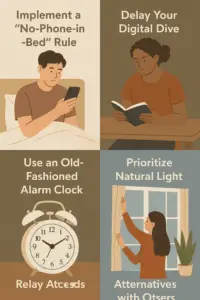
* 30 mins before bed commit to putting your screens away and extend gradually
* Set a “power-down alarm” as a reminder to power down all devices
* Charge devices outside your bedroom, removing temptation, invest in a traditional alarm clock
* Tell family/housemates so they don’t disrupt your routine.
👉 Think of this as your sleep training window — you’re teaching your brain it’s time to rest.
This dedicated screen-free window isn’t about deprivation; it’s about creating a sacred space for relaxation and self-care. It’s an investment in the quality of your sleep, and ultimately, the quality of your waking life.

Simple Evening Activities To Help You Avoid Screens
So what do you do once screens are off? Replace them with soothing activities.
Here are some enriching, sleep-promoting activities to fill your screen-free evening window:
* 📖 Read a physical book → stimulates imagination without blue light
* 🎧 Listen to calming audio → podcasts, guided meditation, or music
* ✍️ Journal or reflect → unload worries, record gratitude, or plan tomorrow
* 🧘 Gentle stretching or yoga → release muscle tension
* 🌿 Meditation or deep breathing → calm your nervous system
* 🛁 Warm bath or shower → body temperature drop signals sleep
* ☕ Herbal tea ritual → chamomile or lavender, caffeine-free
* 🎨 Quiet hobbies → puzzles, knitting, coloring
* 💬 Light conversation → bond with loved ones without digital distractions.
These activities aren’t just placeholders; they are active investments in your sleep health and overall well-being. By purposefully shifting your evening routine away from screens, you empower your body’s natural sleep mechanisms, transforming frantic evenings into peaceful pathways to profound rest.
Crafting Your Ideal Pre-Bed Routine
You’ve learned why screens are sleep saboteurs and discovered a wealth of screen-free alternatives. Now, it’s time to weave these insights into a powerful, personalized strategy: your ideal pre-bed routine.
This isn’t about rigid rules, but about creating a consistent, soothing sequence of actions that signals to your body and mind: “It’s time to wind down.”
Think of your routine as a gentle ramp that smoothly guides you from the demands of your day into the tranquility of sleep.
Consistency is key here; the more regularly you follow your routine, the more effectively your brain will associate these actions with sleep, making the transition easier over time.
Here’s how to structure a nightly ritual that reinforces deep sleep:
1. Digital Sunset → Set your 2–3 hour no-screen window, place devices outside bedroom
2. Decompression Zone → Light reading, journaling, tidying, or calm conversation
3. Body Relaxation → Warm bath, stretching, self massage or herbal tea
4. Quiet Mind Practice → Meditation, deep breathing, or visualization (15-30 min before bed)
5. Optimize Bedroom Environment → cool, dark, quiet, and screen-free
Consistency matters more than perfection — your brain learns to associate these steps with sleep.
You’re not just avoiding screens; you’re actively creating the optimal conditions for your body’s natural sleep mechanisms to flourish. It’s a powerful act of self-care that will unlock deeper, more restorative sleep and transform your waking life.
The Unlocked Benefits: What Deeper Sleep Gives You
The benefits of unlocking deeper, more restorative sleep extend far beyond simply feeling less tired. They touch every aspect of your physical, mental, and emotional well-being, transforming your waking life in profound ways.
Imagine waking up feeling genuinely refreshed, alert, and ready to tackle the day, not dragged out of bed by an insistent alarm. This isn’t a pipe dream; it’s the direct result of giving your body and brain the high-quality sleep they desperately crave.
Here’s what you unlock when you prioritize profound rest:
Mental Clarity
* Better focus & concentration
* Enhanced memory
* Boosted creativity & problem-solving
Physical Health
* Stronger immune system
* Balanced hormones
* More energy & faster recovery
Emotional Well-Being
* Reduced irritability and anxiety
* Better emotional regulation
* Greater resilience to stress
Life Quality
* Stronger relationships
* Higher productivity
* Safer driving & sharper reflexes
* More joy in daily life
Your Screen-Free Promise
You now understand that the glowing screen isn’t just a distraction; it’s a direct interference with your body’s innate ability to achieve the deep, restorative sleep you deserve.
It’s time to make your commitment to better sleep:
* Enforce your digital sunset
* Replace scrolling with calming rituals
* Keep your bedroom a true sleep sanctuary
*Be patient and persistent — habit change takes time
This isn’t about giving up screens forever. It’s about reclaiming your nights so your body and brain can rest, recharge, and thrive.
👉 Imagine waking refreshed, energized, and clear-minded every morning. That’s the power of going screen-free before bed.
Your path to restful nights begins now. Make the promise to yourself. Embrace the quiet. And unlock the incredible power of truly deep, restorative sleep. Your future, well-rested self will thank you.
Recommended Reading
Should You Shower Before Bed? Science Says Yes (or No)
Ever wondered if your nightly shower ritual is truly beneficial? This post cuts through the myths to reveal the science behind showering before bed, exploring its surprising advantages for sleep quality, skin health, and overall well-being. Discover how a well-timed shower can optimize your bedtime routine and contribute to a healthier you. Understanding Body Temperature […]
Tired of Tossing? 7 Simple Hacks for Instantly Better Sleep
If you’ve been lying awake at night staring at the ceiling, you’re not alone. Millions of people struggle with falling asleep or staying asleep, but the good news is that a few small changes can make a big difference. Whether you’re battling a restless mind or an unpredictable sleep schedule, these 7 simple hacks can […]
Optional Resource: Sleep Blueprint Guide