How To Fix A Sleep Schedule After Staying Up All Night
If you stayed up all night — whether from work, stress, travel, or just a late binge session — you’re probably wondering how to fix your sleep schedule quickly.
The good news: one bad night does not permanently damage your sleep rhythm.
The key is correcting timing cues the next day without overcorrecting.
Quick Answer
To fix your sleep schedule after staying up all night, wake up at your target time the next morning, get morning light exposure, avoid long daytime naps, and go to bed at a reasonable hour — not extremely early. Consistency over the next few days restores your rhythm.
Why Pulling an All-Nighter Disrupts Your Rhythm
Your circadian rhythm depends heavily on wake time consistency and light exposure.
When you stay awake all night:
- Your internal clock becomes misaligned
- Sleep pressure builds excessively
- Light exposure timing shifts
- Your bedtime may drift later the next day
But your rhythm is resilient. It responds quickly to consistent cues.
Step-by-Step: How To Fix Your Sleep Schedule
1. Do Not Sleep All Day
If possible, stay awake until your normal bedtime.
If you must nap, limit it to 20–30 minutes before 2 PM.
Long naps reduce nighttime sleep pressure and make it harder to fall asleep later.
2. Wake Up at Your Target Time the Next Day
Even if you fall asleep late, wake up at your chosen wake time.
This re-anchors your circadian rhythm quickly.
Wake time is more powerful than bedtime for schedule correction.
3. Get Morning Light Exposure
Expose yourself to bright light within 30 minutes of waking.
Natural daylight is best.
Morning light helps reset melatonin timing and shift your internal clock back into alignment.
4. Avoid Going to Bed Extremely Early
You may feel exhausted in the afternoon or early evening.
Avoid going to bed several hours earlier than usual.
Instead, aim for your normal bedtime or slightly earlier (30–60 minutes).
This prevents over-shifting your rhythm.
5. Avoid Heavy Caffeine Late in the Day
Using caffeine to push through the day is common, but avoid it after early afternoon.
Late caffeine delays sleep onset and prolongs recovery.

What To Expect The Next Few Days
After staying up all night, you may experience:
- Increased sleepiness
- Slightly earlier bedtime
- Deeper sleep the first night
- Mild fatigue for 1–2 days
Most people stabilize within 1–3 days if they maintain consistent wake time and light exposure.
If your schedule was already drifting before the all-nighter, recovery may take slightly longer.
For deeper correction strategies, see: Reset Sleep Cycle Guide
Is Staying Up All Night A Good Way To Reset Sleep?
Some people intentionally stay up all night to “force” a reset.
While this can temporarily shift timing, it often leads to:
- Rebound fatigue
- Inconsistent follow-through
- Weekend oversleep
- Another delay cycle
Gradual correction is more stable long term.
How Long Does It Take To Fully Recover?
If your schedule was stable before the all-nighter, recovery usually takes 1 to 3 days.
If your sleep timing was already inconsistent, it may take 5 to 7 days of steady correction.
For a full timeline breakdown, read: How Long Does It Take to Reset Your Sleep Cycle?
Preventing Future Schedule Disruption
To reduce the impact of future late nights:
- Maintain consistent wake time
- Limit weekend sleep-ins
- Reduce late-night screen exposure
- Use structured reset phases if drift occurs
You can follow the phased method here: Reset Sleep Cycle Framework
Or use the daily tool: Sleep Cycle Reset Checklist
Frequently Asked Questions
Can one all-nighter ruin your sleep schedule?
One all-nighter usually does not cause permanent disruption. Consistent wake time over the next few days typically restores rhythm.
Should I sleep all day after staying up all night?
Sleeping all day often delays bedtime further. Short naps are acceptable, but long daytime sleep may prolong recovery.
Is it better to stay awake or sleep a few hours?
If you can get a short block of sleep without oversleeping, it may help. However, consistency the next day is more important than total sleep that night.
Key Takeaway
Staying up all night does not permanently damage your sleep rhythm. Anchor your wake time, use morning light exposure, avoid long naps, and return to consistent timing. Most people recover within a few days.
Important Note
This article provides general educational information about sleep timing and schedule recovery. It is not intended to diagnose or treat medical sleep conditions. If you experience persistent or severe sleep concerns, consult a qualified healthcare professional.
What Is Social Jet Lag? (And How It Affects Your Sleep)
If you sleep one schedule during the week and a completely different one on weekends, you may be experiencing something called social jet lag.
Social jet lag happens when your sleep timing shifts back and forth due to social habits — not travel. Even though you’re not changing time zones, your body clock experiences a similar disruption.
Over time, this pattern can make it harder to fall asleep on Sunday night, wake up on Monday morning, and maintain consistent energy throughout the week.
Quick Answer
Social jet lag occurs when your weekend sleep schedule differs significantly from your weekday schedule. Large shifts in wake time can disrupt your circadian rhythm, making it harder to maintain consistent sleep timing.

Why Is It Called “Social” Jet Lag?
Traditional jet lag happens when you travel across time zones. Your internal clock remains aligned with your old location while your environment has changed.
Social jet lag works similarly — but instead of travel, the shift is caused by lifestyle habits.
For example:
- Waking at 6:30 AM during the week
- Sleeping until 10:00 AM on weekends
- Going to bed later on Friday and Saturday
That 3 to 4 hour difference acts like traveling across time zones twice every week.
This pattern often overlaps with broader inconsistent sleep schedule effects that gradually weaken rhythm stability.
How Social Jet Lag Affects Your Body
Your circadian rhythm thrives on consistency. When wake time varies widely:
- Melatonin timing shifts
- Morning alertness decreases
- Bedtime becomes less predictable
- Monday mornings feel harder
- Sunday night sleep often becomes restless
Even small repeated shifts can accumulate over time.
Common Signs Of Social Jet Lag
You might be experiencing social jet lag if:
- You struggle to fall asleep Sunday night
- Monday mornings feel especially difficult
- Your bedtime drifts later each weekend
- You feel more alert late at night
- Your sleep schedule feels different every few days
This pattern often develops gradually.
How Much Schedule Difference Is Too Much?
A small variation is normal. Most sleep experts suggest keeping weekend wake time within about 60 minutes of your weekday schedule.
When the difference grows to 2–4 hours, your body clock begins to shift noticeably.
The larger the difference, the stronger the “mini jet lag” effect.
How To Reduce Social Jet Lag
1. Stabilize Your Wake Time
Try to wake within 60 minutes of your weekday schedule on weekends.
This is the most powerful correction step.
2. Avoid Large Weekend Sleep-Ins
If you need extra rest, consider:
- Going to bed slightly earlier
- Taking a short afternoon nap (20–30 minutes)
Instead of sleeping several hours later.
3. Maintain Morning Light Exposure
Light shortly after waking helps reinforce circadian rhythm timing, even on weekends.
4. Use Gradual Corrections
If your schedule has drifted significantly, follow a structured reset plan rather than making drastic shifts.
You can review the: Reset Sleep Cycle Guide
Or follow the phased: Sleep Reset Framework
How Long Does It Take To Recover From Social Jet Lag?
If weekend shifts are mild, recovery often occurs within a few days of consistent wake timing.
If shifts are large and repeated for months, correction may take 1 to 2 weeks of steady routine.
For more detail, read: How Long Does It Take to Reset Your Sleep Cycle?
Is Social Jet Lag Dangerous?
Social jet lag itself is not a disease, but long-term circadian inconsistency may contribute to:
- Reduced sleep quality
- Daytime fatigue
- Mood variability
- Difficulty maintaining consistent routines
Maintaining stable timing supports overall rhythm health.
Frequently Asked Questions
Is social jet lag the same as insomnia?
No. Insomnia involves difficulty falling or staying asleep despite opportunity. Social jet lag results from inconsistent sleep timing.
How many hours difference causes social jet lag?
Differences of 2 hours or more between weekday and weekend wake times often produce noticeable effects.
Can social jet lag affect energy levels?
Yes. Frequent timing shifts can reduce morning alertness and create Monday fatigue.
Key Takeaway
Social jet lag happens when weekend sleep timing differs significantly from weekday schedules. Even without travel, repeated shifts can disrupt your internal clock. Keeping wake time consistent is one of the simplest ways to protect sleep stability.
Important Note
This article provides general educational information about sleep timing. It is not intended to diagnose or treat medical sleep conditions. If you experience persistent or severe sleep concerns, consult a qualified healthcare professional.
How To Fix A Delayed Sleep Schedule
If you consistently feel alert late at night but exhausted in the morning, you may be dealing with a delayed sleep schedule.
A delayed sleep schedule happens when your internal clock shifts later than your desired bedtime. Instead of feeling sleepy at 10 or 11 PM, you might not feel tired until 1 or 2 AM — or even later.
The good news is that this pattern is adjustable. With gradual timing shifts and consistent wake cues, most delayed schedules can be corrected over 1 to 2 weeks.
Quick Answer
To fix a delayed sleep schedule, anchor your wake time, increase morning light exposure, and gradually shift bedtime earlier by 15 to 30 minutes every few days. Consistency matters more than forcing sleep.
What Is A Delayed Sleep Schedule?
A delayed sleep schedule means your natural sleep window has shifted later than your preferred routine.
Common signs include:
- Not feeling sleepy until very late
- Difficulty waking up for work or school
- Feeling most alert late at night
- Hitting snooze repeatedly
- Sleeping in on weekends
This pattern often develops gradually through inconsistent wake times, late-night light exposure, or repeated weekend sleep-ins.
Delayed sleep patterns are closely tied to circadian timing, which we explain in detail in circadian rhythm explained.
Why Does A Sleep Schedule Become Delayed?
Your sleep timing is controlled by your circadian rhythm — your internal body clock.
This rhythm responds strongly to:
- Light exposure
- Wake time consistency
- Meal timing
- Activity patterns
- Screen use at night
When wake time drifts later, your body clock shifts with it. Over time, your natural sleep window moves deeper into the night.
This can create a cycle where:
Late bedtime → Late wake time → Even later bedtime
Breaking that cycle requires correcting timing cues.
Step-by-Step: How To Fix A Delayed Sleep Schedule
1. Anchor Your Wake Time First
Wake up at the same time every day, including weekends.
This is the most important step. Wake time influences circadian rhythm more strongly than bedtime.
Even if you fall asleep late, wake up at your chosen time.
2. Get Morning Light Immediately
Expose yourself to bright light within 30 minutes of waking.
Natural daylight works best, but bright indoor light is helpful if sunlight is limited.
Morning light signals your brain that the day has started and helps shift your internal clock earlier.
3. Shift Bedtime Gradually
Move bedtime earlier by 15 to 30 minutes every few days.
Avoid jumping your bedtime by hours at once. Large shifts usually lead to frustration and lying awake.
Small, consistent adjustments are more sustainable.
4. Reduce Late-Night Light Exposure
Dim lights 60 to 90 minutes before your target bedtime.
Reduce stimulating activities such as:
- Bright screens
- Intense gaming
- High-energy content
- Late-night work
Lower evening light helps your body prepare for sleep earlier.
5. Limit Weekend Sleep-Ins
Sleeping in by several hours can undo weekday progress.
Try to keep weekend wake time within about 60 minutes of your weekday schedule.

How Long Does It Take To Fix A Delayed Sleep Schedule?
Mild delay often improves within 5 to 7 days.
More significant delays may take 10 to 14 days of consistent wake time anchoring and gradual bedtime adjustments.
For a full timeline explanation, read: How Long Does It Take to Reset Your Sleep Cycle?
What Not To Do
Avoid these common mistakes:
- Staying up all night to “force” an earlier bedtime
- Taking long daytime naps
- Changing wake time daily
- Relying on caffeine late in the afternoon
- Drastically shifting bedtime
Consistency beats intensity.
When A Delayed Schedule Becomes A Habit
If your schedule has been delayed for months or years, correction may take slightly longer. The longer the pattern has been reinforced, the more consistent you must be with timing cues.
Patience and repetition are key.
Structured Reset Support
If you want a full structured approach, review the: Reset Sleep Cycle Guide
To follow a phased method, see the: Reset Sleep Cycle Framework
For daily tracking, use the: Sleep Cycle Reset Checklist
Frequently Asked Questions
Why am I not sleepy until 2 AM?
This often results from a delayed circadian rhythm caused by late wake times, nighttime light exposure, or irregular routines.
Can I fix a delayed sleep schedule quickly?
Small delays may improve within a week. Larger delays usually require 1 to 2 weeks of consistent wake time and gradual bedtime adjustments.
Is staying up all night a good way to reset sleep?
While it may temporarily shift timing, it often increases fatigue and makes consistency harder the following days.
Key Takeaway
To fix a delayed sleep schedule, correct timing cues rather than forcing sleep. Anchor your wake time, use morning light strategically, shift bedtime gradually, and stay consistent for 1 to 2 weeks.
Important Note
This article provides general educational information about sleep timing. It is not intended to diagnose or treat medical sleep conditions. If you experience persistent or severe sleep difficulties, consult a qualified healthcare professional.
How Long Does It Take To Reset Your Sleep Cycle?
If your sleep schedule feels off, one of the first questions you probably ask is:
How long does it take to reset your sleep cycle?
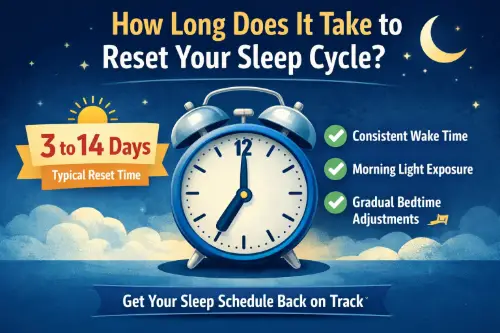
The short answer is that most people can reset their sleep cycle in 3 to 14 days, depending on how disrupted their schedule has become and how consistent they are with wake time and daily habits.
While some improvement may be noticeable within a few days, full rhythm stabilization usually takes at least one to two weeks of steady timing.
Quick Answer
Most people can reset their sleep cycle in 3 to 14 days. Minor schedule drift may improve within a few days, while more significant disruption often takes one to two weeks of consistent wake time anchoring and gradual bedtime adjustments.
Why It Doesn’t Happen Overnight
Your sleep timing is controlled by your circadian rhythm, an internal clock that responds to:
- Light exposure
- Wake time consistency
- Meal timing
- Daily routine
- Physical activity
When your sleep schedule drifts, your internal clock shifts with it. Resetting that rhythm requires consistent cues over multiple days.
Large, sudden bedtime changes usually do not work well because your body does not instantly adjust to forced timing.
Gradual correction is more effective.
How Disrupted Is Your Sleep Schedule?
The timeline for resetting your sleep cycle depends on how far your timing has shifted.
Mild Drift (1–2 Hours Off)
- Often improves within 3 to 5 days
- Consistent wake time usually corrects quickly
- Morning light exposure speeds adjustment
Moderate Disruption (Several Hours Off)
- Typically takes 7 to 10 days
- Requires gradual bedtime shifts
- Weekend consistency becomes important
Severe Disruption (Late Night Schedule or Long-Term Drift)
- May take 10 to 14+ days
- Needs strong wake time anchoring
- Requires strict light timing and reduced variability
The more consistent you are, the faster the adjustment tends to occur.
What Speeds Up A Sleep Reset?
Certain habits can accelerate the process.
1. Consistent Wake Time
Waking up at the same time every day, including weekends, is the strongest reset lever.
2. Morning Light Exposure
Bright light within 30 minutes of waking signals your brain that the day has started and helps shift your internal clock.
3. Gradual Bedtime Shifts
Adjust bedtime in 15 to 30 minute increments every few days instead of making large jumps.
4. Reduced Weekend Sleep-Ins
Sleeping in by several hours can undo weekday progress.
What Slows Down A Sleep Reset?
Common behaviors can delay improvement:
- Large weekend sleep-ins
- Long daytime naps
- Late-night screen exposure
- Inconsistent wake times
- Caffeine too late in the day
Even small inconsistencies can compound over a week.
What To Expect During The First Week
During the first few days of a reset, you may notice:
- Feeling alert at your old bedtime
- Mild daytime sleepiness
- Waking earlier than usual
- Slight difficulty falling asleep
These effects are normal while your body clock adjusts.
Improvements often become noticeable around days 5 to 7, with stronger stabilization by days 10 to 14.
Can You Reset Your Sleep Cycle In One Night?
Resetting your sleep cycle in one night is unlikely.
Staying up all night to “force” an earlier bedtime may temporarily shift your schedule, but it often leads to rebound fatigue and inconsistent follow-through.
Gradual, repeatable adjustments are typically more stable.
How To Reset Your Sleep Cycle Safely
If you are actively trying to correct your schedule, follow a structured approach:
- Anchor your wake time first
- Get morning light exposure
- Shift bedtime gradually
- Limit weekend variability
- Maintain consistency for at least 7 to 14 days
If you need a full step-by-step plan, review the reset sleep cycle guide to apply these timelines properly.
To follow a daily implementation plan, use the Sleep Cycle Reset Checklist.
Frequently Asked Questions
How long does it take to fix a messed up sleep schedule?
Most irregular sleep schedules improve within 1 to 2 weeks when wake time is stabilized and bedtime adjustments are gradual.
What is the fastest way to reset your body clock?
The fastest sustainable method is waking at the same time daily and getting bright light exposure in the morning.
Why does my sleep schedule keep shifting later?
Sleep schedules often shift later due to inconsistent wake times, weekend sleep-ins, and late-night light exposure.
Key Takeaway
Most people can reset their sleep cycle in 3 to 14 days with consistent timing. The more stable your wake time and light exposure, the faster your body clock realigns. Gradual adjustments are more effective than drastic schedule changes.
Important Note
This article provides general educational information about sleep timing. It is not intended to diagnose or treat medical sleep conditions. If you experience persistent or severe sleep concerns, consult a qualified healthcare professional.
Reset Sleep Cycle Guide
If your sleep schedule is off — whether from staying up late, shift work, travel, stress, or inconsistent habits — you’re not alone. Many people struggle with irregular bedtimes, morning grogginess, and difficulty falling asleep at the right time.
The good news is that your sleep-wake rhythm is adjustable. With structured timing and consistent daily cues, you can reset your sleep cycle and gradually return your body to a stable, predictable rhythm that supports deeper sleep and easier mornings.
This process works by strengthening your internal clock, which you can learn more about in our guide to how circadian rhythm works.
The key is correcting timing, not forcing sleep.
This guide explains why your sleep cycle drifts, how to reset your sleep schedule safely, and what to expect during the adjustment process.
Quick Answer: To reset your sleep cycle, anchor a consistent wake time, get morning light exposure, and adjust bedtime gradually over 7 to 14 days. Small steady changes are more effective than drastic schedule shifts.
What Is A Sleep Cycle Reset?
A sleep cycle reset is a structured, gradual adjustment of your sleep timing. It focuses on stabilizing wake time first, then narrowing bedtime variability, and reinforcing consistent daily cues that support rhythm alignment.
The goal is not to dramatically change your schedule overnight. Instead, it is to reduce timing swings and rebuild a predictable sleep-wake pattern over several days or weeks.
What Causes Your Sleep Cycle To Get Off Track?
Your sleep cycle is governed by your circadian rhythm – an internal clock that regulates energy, melatonin levels, hunger, alertness, and sleep. When that clock gets disrupted, your sleep suffers. Common causes include:
* Staying up late or oversleeping
* Irregular sleep/wake times
* Excessive nighttime screen exposure
* Jet lag
* Shift work
* Stress, anxiety, or overthinking at night
* Too little daylight exposure
* Caffeine or alcohol too close to bedtime
* Sleeping in on weekends (“social jet lag”)
Resetting your sleep cycle means restoring your circadian rhythm and with the right habits, your body naturally falls back into alignment.
Why Resetting Your Sleep Timing Works
Your body follows a roughly 24-hour internal rhythm that responds to light, wake time consistency, and behavioral cues. When wake time varies widely, that rhythm becomes less predictable. A structured reset works by strengthening daily timing signals, especially morning light exposure and consistent rising time.
By stabilizing wake time first, you give your internal clock a fixed reference point. Bedtime naturally becomes easier to regulate once the morning anchor is consistent.
Signs Your Sleep Schedule Has Drifted
- Bedtime shifts by more than 1–2 hours throughout the week
- Weekend wake time differs significantly from weekday wake time
- Difficulty falling asleep at your intended bedtime
- Morning grogginess despite spending adequate time in bed
- Feeling alert late at night but tired in the morning
If several of these patterns apply, a structured reset may help restore consistency.
Who This Sleep Reset Is Best For
- Individuals with gradually drifting bedtimes
- Those recovering from travel or schedule disruption
- People with inconsistent weekend sleep timing
- Anyone rebuilding sleep consistency after lifestyle changes
This checklist is designed for general rhythm adjustment. It is not intended for shift workers or individuals with diagnosed sleep disorders requiring medical guidance.
How Long Does It Take To Reset a Sleep Cycle?
Most people can reset their sleep cycle in 3–14 days, depending on how irregular it has become. The more consistent you are, the faster the adjustment.
Before You Start
Successful resets are gradual and consistent. Before beginning, consider the following:
- Choose a realistic wake time you can maintain daily
- Avoid shifting bedtime by more than 15–30 minutes at a time
- Expect temporary adjustment discomfort
- Commit to at least 7–14 days of steady effort
Consistency matters more than intensity.
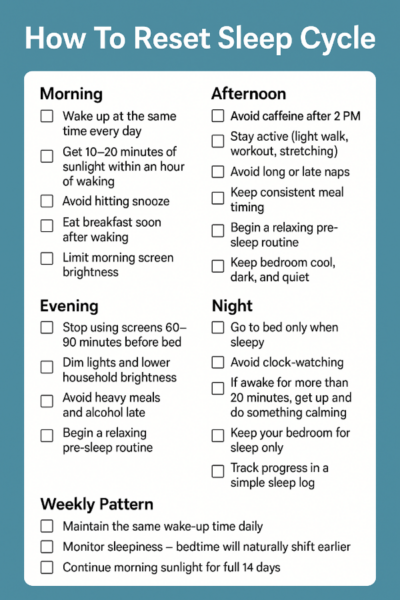
The Sleep Cycle Reset Checklist
Phase 1: Anchor Your Wake Time
- Set a consistent wake time (including weekends when possible)
- Get light exposure within 30 minutes of waking
- Avoid hitting snooze repeatedly
Phase 2: Adjust Bedtime Gradually
- Shift bedtime earlier or later by 15–30 minutes every few days
- Avoid drastic schedule jumps
- Go to bed only when sleepy
Phase 3: Reinforce Morning Cues
- Hydrate shortly after waking
- Engage in light movement or stretching
- Limit early screen exposure
Phase 4: Stabilize Evening Routine
- Dim lights 60–90 minutes before bed
- Reduce stimulating activities
- Follow a consistent wind-down routine
Phase 5: Maintain Consistency
- Keep wake time stable even after improvement
- Avoid large weekend sleep-ins
- Track timing patterns weekly
Typical Reset Timeline
| Day Range | Primary Focus |
|---|---|
| Days 1–3 | Stabilize wake time and morning light exposure |
| Days 4–7 | Gradually narrow bedtime variability |
| Days 8–14 | Maintain steady timing and reinforce habits |
Common Sleep Reset Mistakes
- Changing bedtime by multiple hours at once: Large shifts often create more disruption and make it harder to fall asleep naturally.
- Sleeping in drastically on weekends: Extended weekend sleep can undo weekday rhythm progress.
- Using long naps to compensate: Long daytime naps reduce nighttime sleep pressure.
- Stopping the reset after only a few days: Most resets require consistent effort for at least one to two weeks.
Gradual adjustments and consistency produce more stable results than extreme corrections.
Frequently Asked Questions About Resetting Your Sleep Cycle
How do I reset my sleep cycle naturally?
You can reset your sleep cycle naturally by anchoring a consistent wake time, getting morning light exposure, and gradually adjusting bedtime in 15 to 30 minute increments. Consistency is more effective than drastic changes.
How long does it take to fix a messed up sleep schedule?
Most people can fix an irregular sleep schedule in 3 to 14 days. The more consistent your wake time and light exposure, the faster your circadian rhythm can stabilize.
What is the fastest way to reset your body clock?
The fastest sustainable way to reset your body clock is to wake up at the same time every day and expose yourself to bright light shortly after waking. Morning timing cues strongly influence circadian rhythm alignment.
Can I reset my sleep cycle in one night?
Resetting your sleep cycle in one night is unlikely. Sudden bedtime shifts often make it harder to fall asleep. Gradual adjustments over several days typically produce better long-term results.
Why does my sleep schedule keep shifting later?
Sleep schedules often shift later due to inconsistent wake times, weekend sleep-ins, late-night screen exposure, or irregular routines. Small timing drifts can compound over time if not corrected early.
Is staying up all night a good way to reset sleep?
Staying up all night may temporarily shift your schedule, but it often increases fatigue and makes consistency harder the following days. Gradual timing adjustments are usually more stable and sustainable.
How do I reset my sleep schedule after vacation or travel?
After travel or vacation, return to your normal wake time immediately, prioritize morning light exposure, and reduce bedtime variability over several days. Small, consistent corrections work better than extreme adjustments.
Why am I tired in the morning but awake at night?
Feeling tired in the morning but alert at night often indicates delayed sleep timing. When wake time drifts later, your internal rhythm shifts, increasing nighttime alertness and reducing morning energy.
How This Connects To Your Sleep System
A reset is most effective when supported by daily habit structure. These related tools can help reinforce timing consistency and track progress over time:
Core Reset Rules
- Anchor wake time first
- Shift bedtime gradually
- Limit weekend variability
- Use light exposure strategically
- Commit for at least 7–14 days
Key Takeaway
A sleep cycle reset is not about sudden change. It is about stabilizing wake time, narrowing timing variability, and reinforcing consistent daily cues. Small, steady adjustments typically produce the most reliable improvements.
Important Note
This guide provides educational information for general sleep awareness. It is not intended to diagnose or treat medical sleep conditions. If you experience persistent or severe sleep concerns, consult a qualified healthcare professional.