Reset Sleep Cycle Guide
If your sleep schedule is off — whether from staying up late, shift work, travel, stress, or inconsistent habits — you’re not alone. Many people struggle with irregular bedtimes, morning grogginess, and difficulty falling asleep at the right time.
The good news is that your sleep-wake rhythm is adjustable. With structured timing and consistent daily cues, you can reset your sleep cycle and gradually return your body to a stable, predictable rhythm that supports deeper sleep and easier mornings.
This process works by strengthening your internal clock, which you can learn more about in our guide to how circadian rhythm works.
The key is correcting timing, not forcing sleep.
This guide explains why your sleep cycle drifts, how to reset your sleep schedule safely, and what to expect during the adjustment process.
Quick Answer: To reset your sleep cycle, anchor a consistent wake time, get morning light exposure, and adjust bedtime gradually over 7 to 14 days. Small steady changes are more effective than drastic schedule shifts.
What Is A Sleep Cycle Reset?
A sleep cycle reset is a structured, gradual adjustment of your sleep timing. It focuses on stabilizing wake time first, then narrowing bedtime variability, and reinforcing consistent daily cues that support rhythm alignment.
The goal is not to dramatically change your schedule overnight. Instead, it is to reduce timing swings and rebuild a predictable sleep-wake pattern over several days or weeks.
What Causes Your Sleep Cycle To Get Off Track?
Your sleep cycle is governed by your circadian rhythm – an internal clock that regulates energy, melatonin levels, hunger, alertness, and sleep. When that clock gets disrupted, your sleep suffers. Common causes include:
* Staying up late or oversleeping
* Irregular sleep/wake times
* Excessive nighttime screen exposure
* Jet lag
* Shift work
* Stress, anxiety, or overthinking at night
* Too little daylight exposure
* Caffeine or alcohol too close to bedtime
* Sleeping in on weekends (“social jet lag”)
Resetting your sleep cycle means restoring your circadian rhythm and with the right habits, your body naturally falls back into alignment.
Why Resetting Your Sleep Timing Works
Your body follows a roughly 24-hour internal rhythm that responds to light, wake time consistency, and behavioral cues. When wake time varies widely, that rhythm becomes less predictable. A structured reset works by strengthening daily timing signals, especially morning light exposure and consistent rising time.
By stabilizing wake time first, you give your internal clock a fixed reference point. Bedtime naturally becomes easier to regulate once the morning anchor is consistent.
Signs Your Sleep Schedule Has Drifted
- Bedtime shifts by more than 1–2 hours throughout the week
- Weekend wake time differs significantly from weekday wake time
- Difficulty falling asleep at your intended bedtime
- Morning grogginess despite spending adequate time in bed
- Feeling alert late at night but tired in the morning
If several of these patterns apply, a structured reset may help restore consistency.
Who This Sleep Reset Is Best For
- Individuals with gradually drifting bedtimes
- Those recovering from travel or schedule disruption
- People with inconsistent weekend sleep timing
- Anyone rebuilding sleep consistency after lifestyle changes
This checklist is designed for general rhythm adjustment. It is not intended for shift workers or individuals with diagnosed sleep disorders requiring medical guidance.
How Long Does It Take To Reset a Sleep Cycle?
Most people can reset their sleep cycle in 3–14 days, depending on how irregular it has become. The more consistent you are, the faster the adjustment.
Before You Start
Successful resets are gradual and consistent. Before beginning, consider the following:
- Choose a realistic wake time you can maintain daily
- Avoid shifting bedtime by more than 15–30 minutes at a time
- Expect temporary adjustment discomfort
- Commit to at least 7–14 days of steady effort
Consistency matters more than intensity.
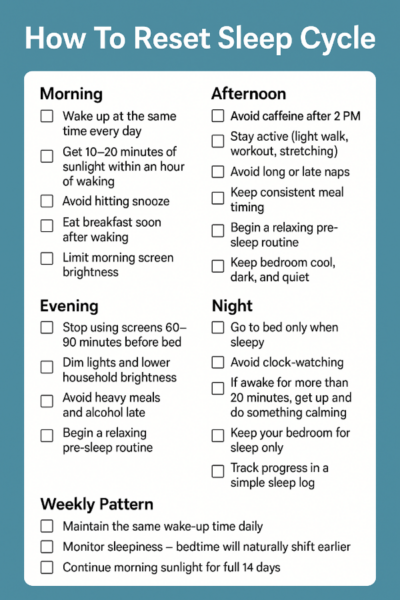
The Sleep Cycle Reset Checklist
Phase 1: Anchor Your Wake Time
- Set a consistent wake time (including weekends when possible)
- Get light exposure within 30 minutes of waking
- Avoid hitting snooze repeatedly
Phase 2: Adjust Bedtime Gradually
- Shift bedtime earlier or later by 15–30 minutes every few days
- Avoid drastic schedule jumps
- Go to bed only when sleepy
Phase 3: Reinforce Morning Cues
- Hydrate shortly after waking
- Engage in light movement or stretching
- Limit early screen exposure
Phase 4: Stabilize Evening Routine
- Dim lights 60–90 minutes before bed
- Reduce stimulating activities
- Follow a consistent wind-down routine
Phase 5: Maintain Consistency
- Keep wake time stable even after improvement
- Avoid large weekend sleep-ins
- Track timing patterns weekly
Typical Reset Timeline
| Day Range | Primary Focus |
|---|---|
| Days 1–3 | Stabilize wake time and morning light exposure |
| Days 4–7 | Gradually narrow bedtime variability |
| Days 8–14 | Maintain steady timing and reinforce habits |
Common Sleep Reset Mistakes
- Changing bedtime by multiple hours at once: Large shifts often create more disruption and make it harder to fall asleep naturally.
- Sleeping in drastically on weekends: Extended weekend sleep can undo weekday rhythm progress.
- Using long naps to compensate: Long daytime naps reduce nighttime sleep pressure.
- Stopping the reset after only a few days: Most resets require consistent effort for at least one to two weeks.
Gradual adjustments and consistency produce more stable results than extreme corrections.
Frequently Asked Questions About Resetting Your Sleep Cycle
How do I reset my sleep cycle naturally?
You can reset your sleep cycle naturally by anchoring a consistent wake time, getting morning light exposure, and gradually adjusting bedtime in 15 to 30 minute increments. Consistency is more effective than drastic changes.
How long does it take to fix a messed up sleep schedule?
Most people can fix an irregular sleep schedule in 3 to 14 days. The more consistent your wake time and light exposure, the faster your circadian rhythm can stabilize.
What is the fastest way to reset your body clock?
The fastest sustainable way to reset your body clock is to wake up at the same time every day and expose yourself to bright light shortly after waking. Morning timing cues strongly influence circadian rhythm alignment.
Can I reset my sleep cycle in one night?
Resetting your sleep cycle in one night is unlikely. Sudden bedtime shifts often make it harder to fall asleep. Gradual adjustments over several days typically produce better long-term results.
Why does my sleep schedule keep shifting later?
Sleep schedules often shift later due to inconsistent wake times, weekend sleep-ins, late-night screen exposure, or irregular routines. Small timing drifts can compound over time if not corrected early.
Is staying up all night a good way to reset sleep?
Staying up all night may temporarily shift your schedule, but it often increases fatigue and makes consistency harder the following days. Gradual timing adjustments are usually more stable and sustainable.
How do I reset my sleep schedule after vacation or travel?
After travel or vacation, return to your normal wake time immediately, prioritize morning light exposure, and reduce bedtime variability over several days. Small, consistent corrections work better than extreme adjustments.
Why am I tired in the morning but awake at night?
Feeling tired in the morning but alert at night often indicates delayed sleep timing. When wake time drifts later, your internal rhythm shifts, increasing nighttime alertness and reducing morning energy.
How This Connects To Your Sleep System
A reset is most effective when supported by daily habit structure. These related tools can help reinforce timing consistency and track progress over time:
Core Reset Rules
- Anchor wake time first
- Shift bedtime gradually
- Limit weekend variability
- Use light exposure strategically
- Commit for at least 7–14 days
Key Takeaway
A sleep cycle reset is not about sudden change. It is about stabilizing wake time, narrowing timing variability, and reinforcing consistent daily cues. Small, steady adjustments typically produce the most reliable improvements.
Important Note
This guide provides educational information for general sleep awareness. It is not intended to diagnose or treat medical sleep conditions. If you experience persistent or severe sleep concerns, consult a qualified healthcare professional.
Optional Resource: Sleep Blueprint Guide